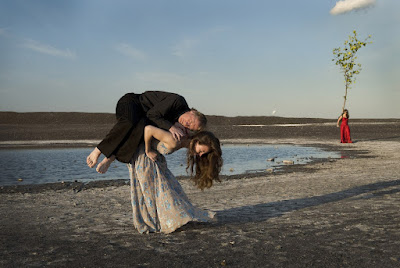
When you know a film as well as I know Red, re-watching it becomes an experience that's as much about yourself as it is about the movie. You find yourself reacting less strongly to aspects which had a tremendous impact on you years ago, whilst scenes which seemed relatively unimportant when you were younger resonate with new force. Like all great works of art, Kieslowski's final film transcends its specific context and speaks to all people of all times, using its simple story of a young student's developing relationship with a mysterious retired judge to explore ideas about the hidden forces that bind us all together. Its technical accomplishments are rivetting to watch: Piotr Sobocinki's photography provides as much evidence as one could ever wish for that a landscape is a character in itself; Zbigniew Preisner's music speaks of bruised tenderness with every haunting note; and Kieslowki's use of tracking shots is intelligent and beguiling, connecting disparate elements with subtle grace. But the real stars are, appropriately enough, the people, especially Irene Jacob and Jean-Louis Trintignant in the lead roles, who effortlessly lend their characters the quirky unknowability that makes each of us unique. An unforgettable tour de force, Red remains my favourite film of all time.
31 December 2011
Film Review: Three Colours Red / Trois Couleurs Rouge [dir. Krzysztof Kieslowski; 1994]
30 December 2011
Film Review: How To Train Your Dragon [dir. Dean DeBlois & Chris Sanders; 2010]
Watching How To Train Your Dragon reminded me of how much there is to enjoy about Hugo. Yes, this story of a skinny (which is Hollywood-ese for 'unmanly', 'geeky', 'socially outcast') young Viking who realises there's more to be gained from trying to befriend rather than kill the dragons with which his fellow villagers insist on going into battle has its fair share of enjoyable moments. But after a while, the oh-so-knowing, ironically contemporary tone of the dialogue (particularly that spoken by the child characters) begins to grate and makes you realise this is precisely the sort of stuff which will date very quickly. The CG animation is wonderful and there are a few genuinely absorbing sequences (notably those depicting the training alluded to in the title) but ultimately, this gets filed under 'Fun But Forgettable'.
Labels:
2010,
animation,
Chris Sanders,
Dean DeBlois,
dragons,
film review,
How To Train Your Dragon,
Hugo
Film Review: Attack The Block [dir. Joe Cornish; 2011]
As far as multiplex-friendly, 90-minute long, 80s-inspired alien invasion movies go, Attack The Block does a decent job of ticking all the right boxes: it pushes its plot along at breakneck speed, it sports an excellent electronic score and it features endearingly minimal special effects. It also goes above and beyond the call of genre duty in its decision to set the action on a south London housing estate (an inspired choice) and to feature a gang of hoodie-wearing, mobile-phone-stealing yoofs as its main characters. But the very aspect that makes Cornish's directorial debut so original and endearing (ie the verbal spats between the youngsters and the adults they encounter as they try to rid the country of monsters) constantly has to make way for the demands of the story, which is a shame, because a bit more talking and a touch less action might have made the film much more memorable.
Labels:
2011,
alien,
Attack The Block,
film review,
Joe Cornish,
London,
sci-fi,
youth
29 December 2011
Film Review: Blue Valentine [dir. Derek Cianfrance; 2010]
Blue Valentine is an excellent example of a film that is let down by its own structure. Clearly, Cianfrance's intention was to portray only the opening and closing stages of a relationship and expect the viewer to fill in the gaps in the middle. This strategy works up to a point and, indeed, there are several evocative scenes which convey the birth and death of love with commendable power. But in order to become truly memorable, the story needed to provide a few more specific details about the reasons for the marital breakdown; passing comments about problems with alcohol abuse and thwarted professional ambitions serve only to make the material seem generic and rather nebulous. Nevertheless, the movie is well worth watching for the almost documentary-like style with which the camera depicts domestic life, the deft use of flashbacks (the entire story is told by cutting back and forth between past and present) and, most notably, for the heartbreaking, intelligent performances from Ryan Gosling and Michelle Williams.
28 December 2011
Film Review: Three Colours White / Trois Couleurs Blanc [dir. Krzysztof Kieslowski; 1994]
When it was released in the mid-90s, White was dimissed as the weakest chapter of Kieslowski's trilogy. Although I've always been very fond of it, I concede that much of its impact is lost in translation, not least because of its tone-deaf English subtitles. However, recent socio-economic events have been kind to this sardonic essay on the pros and cons of equality. In the 90s, Poland was desperate to emulate its western neighbours with a fervour that many Europeans found difficult to comprehend. Now, the imminent collapse of the EU and the rising importance of India, China et al make it somewhat easier to appreciate how much greener the grass can be on the other side of the political fence. With characteristic finesse, Kieslowski weaves these ideas into a tale about a hapless Polish hairdresser who is so stung by the way his French ex-wife treats him, he'll stop at nothing to get his revenge. A masterpiece of black comedy, with a superb score from Zbigniew Preisner.
Labels:
1994,
economics,
equality,
film review,
France,
Kieslowski,
Poland,
politics,
Three Colours,
White,
Zbigniew Preisner
Film Review: Three Colours Blue / Trois Couleurs Bleu [dir. Krzysztof Kieslowski; 1993]
About fifteen minutes into its running time, Blue's protagonist (played with unforgettable precision by Juliette Binoche) is woken from a nap by a burst of orchestral music. She looks straight into the camera, following its movement as it pans from one side of her face to the other. The screen is filled with a deep shade of azure; then it fades to black. We're not sure if the music has really been played somewhere within her earshot or whether it was a product of a fevered dream. Or perhaps it has some ghost-like life of its own. This brief scene pretty much sums up everything you need to know about the first instalment of Kieslowski's much-lauded trilogy: it displays his ability to draw intense performances from his actors; it showcases his extraordinary skill at merging plot with theme, so that the seams between the two are almost invisible; and it highlights his masterful use of filmic language. In short, this enigmatic story of a woman coming to terms with loss and liberty is quite simply one of the most intelligently constructed films of the last 25 years. Watch it on Blu-ray and marvel at the thought that has gone into the composition of every single frame. Beautiful stuff.
Labels:
1993,
bereavement,
Blue,
film review,
freedom,
Juliette Binoche,
Kieslowski,
Three Colours
24 December 2011
Film Review: George Harrison - Living In The Material World [dir. Martin Scorsese; 2011]
Although I was brought up in a Beatle-loving household, George Harrison was spoken about only as one of "the other two" members of the band. Scorsese's documentary of this complex, intriguing cultural figure filled in some of the gaps in my knowledge with considerable finesse. Using new interviews with key figures in Harrison's life (including Paul McCartney, Ringo Starr and his widow, Olivia) as well as expertly chosen film and music clips, the movie charts his rise to stardom, his post-Beatle perfoming career, his work as a film producer and, needless to say, the development of his profound spirituality. Despite his tight focus on his subject, Scorsese allows the material to resonate with wider contextual issues, producing what is, in effect, a chronicle of an entire musical age as much as it is a story of one individual. And although it's almost 4 hours long, it zips by and leaves you wanting much, much more.
23 December 2011
Most Memorable Film Moments Of 2011
Please allow me to indulge in another shameless plug. I've been mentioned not once, but twice in the latest episode of Francine Stock's consistently excellent Film Programme on BBC Radio 4. Please click on this link to listen to the show and if you really haven't got time for the whole thing (your loss!) then just fast forward to the 18th minute. Once you've done that, come back and let me know about your most memorable cinematic moments of the last twelve months.
Labels:
Archipelago,
BBC,
film,
Film Programme,
Francine Stock,
Pina,
Radio 4
22 December 2011
Film Review: Carnage [dir. Roman Polanski; 2011]
Polanski's silver screen version of Yasmina Reza's acclaimed play is so very stagey, one wonders if the director was actually trying, for some reason unknown to the rest of us, to emphasise its non-cinematic tone and texture. In baldly theatrical fashion, two sets of parents meet to discuss a fight between their children. Cue: lots of trendy, psychobabble-inflected conversations about the law of the jungle versus the law of civilised society. A mobile phone is flung into a vase. Tulips are thrown about the room. Kate Winslet vomits on some art books. Various other hystrionics follow. On stage, the set up probably worked quite well. At the cinema, the contrivances are frequently painful. Having said all that, it would be unfair not to mention that Jodie Foster and Christoph Waltz turn in a couple of well-judged, suitably filmic performances and that some aspects of the characters' development are amusing to watch.
Labels:
2011,
Carnage,
Christoph Waltz,
film review,
Jodie Foster,
Kate Winslet,
Roman Polanski,
theatre,
Yasmina Reza
21 December 2011
Film Review: Shame [dir. Steve McQueen; 2011]
Michael Fassbender is without any question one of the finest English-speaking actors working at the moment and I have no doubt that he formulated detailed, intelligent reasons to explain why his character in this particular movie has reached such an extreme degree of emotional isolation. I just wish that this internal planning had been made more overt on screen. Through a series of increasingly tortured incidents – some of which are compelling and moving – McQueen presents several days in the life of a man whose uncontrollable craving for sexual experiences leads him ever closer to self-destruction. But despite the commendable performances and the explicit nature of several scenes, the film remains opaque and rather superficial.
Labels:
2011,
film review,
Michael Fassbender,
sex,
Shame,
Steve McQueen
19 December 2011
Film Review: Christmas Vacation [dir. Jeremiah S Chechik; 1989]
I wonder if, in twenty or so years’ time, part of the pleasure of watching a screwball comedy made in 2011 will come from seeing what will, by then, have become ‘period details’. That’s certainly the case with this particular instalment of the National Lampoon series, which tells the story of creepy-as-ever Chevy Chase trying to bring his wife, children and in-laws together for a traditional Christmas celebration. Yes, many of the gags are funny, but most of the laughs come from realising how the last two decades have seen countless changes in attitudes to women, elderly people… and hair. Amusing, but forgettable.
Labels:
1989,
Chevy Chase,
Christmas,
Christmas Vacation,
comedy,
feminism,
film review,
National Lampoon
18 December 2011
Film Review: A Separation / Jodaeiye Nader Az Simin [dir. Asghar Farhadi; 2011]
With painstaking attention to detail, Farhadi weaves an intricate web of deception and conflicted loyalties based around a middle class man’s attempt to find someone to look after his Alzheimer’s-suffering father whilst he’s away at work. When the woman he employs accuses him of causing her to have a miscarriage, events around the characters become increasingly convoluted. This is cinema at its very best: layered, naturalistic performances; a gripping, thought-provoking, completely unforced narrative; intelligent, unobtrusive directing (featuring excellent handheld camera work and subtle framing). If Kieslowski were still alive and wanting to make a film in Iran, the result may well have been A Separation. Quite superb.
Labels:
2011,
A Separation,
Asghar Farhadi,
drama,
film review,
Iran,
Kieslowski
13 December 2011
Film Review: Hugo [dir. Martin Scorsese; 2011]
It’s helpful to assess Hugo in terms of what it isn’t rather than what it is: it isn’t manic or frenetic; it isn’t desperate to impress with ironic humour; it isn’t patronising to children; it isn’t afraid to keep its plot simple and linear; it isn’t full of 3D clichés. A charming tale of an orphaned boy who tries to understand the world around him whilst keeping the clocks ticking at a Parisian train station, it features excellent performances, sumptuously realised visuals and – with the inclusion of Georges Melies as a key character – a heart-warming respect for the art of cinema. I found some of its comedic moments less than convincing and I confess I’d hoped for a more complicated story, but these are minor criticisms in the face of the movie’s main achievement, which is to present complex themes in an easily-comprehensible, gentle manner to 21st century children and make them enjoy every minute of the experience.
Labels:
2011,
3D,
children,
cinema,
film review,
Georges Melies,
Hugo,
Martin Scorsese
Subscribe to:
Posts (Atom)